
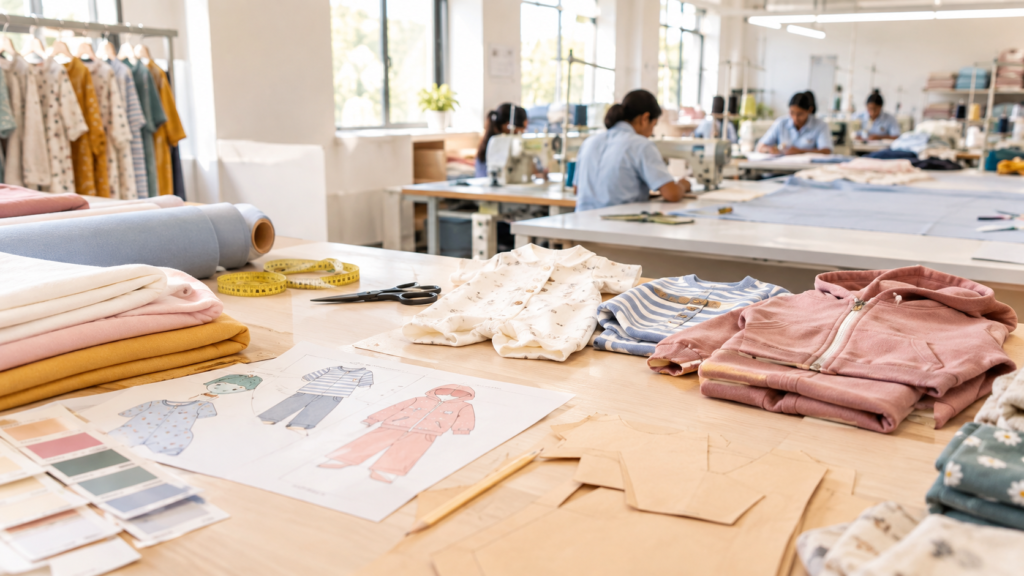
A great kidswear collection rarely begins on a sewing machine. It begins with an idea.
Maybe you have a sketch for a new baby romper. Perhaps you have a complete collection concept for a children’s clothing brand. Or you may already have an established kidswear business and want to turn your next design into a reliable, production-ready garment.
But how does that initial idea become an actual garment that can sit on a store shelf?
Between a sketch and a finished product are several important stages: understanding the design, selecting the right fabric, developing patterns, creating samples, making adjustments, producing the garments, checking quality, and finally preparing them for delivery.
This is where the right kids’ clothing manufacturer can make a significant difference.
A capable manufacturing partner doesn’t simply produce garments according to instructions. The manufacturer works with your requirements, helps translate your concept into a practical product, pays attention to children’s comfort and safety, manages production, and ensures that the finished garment reflects your original vision.
In this guide, let’s take a closer look at how a kids’ clothing manufacturer can take a design from sketch to store shelf.
1. Understanding Your Design and Brand Requirements
Every successful garment starts with a clear understanding of what needs to be created.
Before production begins, a manufacturer needs to understand your design concept and the purpose of the garment.
This may include:
- Your design sketches or reference images
- Target age group
- Size range
- Fabric preferences
- Colours
- Prints and patterns
- Garment measurements
- Fit requirements
- Branding and labels
- Buttons, zippers, snaps, or other accessories
- Packaging requirements
- Expected order quantity
- Target market
For a children’s clothing brand, these details are particularly important because a garment needs to balance appearance, comfort, durability, and practicality.
A design that looks attractive on paper may need adjustments before it becomes suitable for actual production.
This is why communication between the brand and manufacturer is one of the most important parts of the process.
At Cottono Kids, the in-house design team works with clients to understand their vision and translate it into children’s garments. The company describes its services as covering the manufacturing journey from raw-material sourcing through production and packaging.
2. Choosing the Right Fabric
Once the design requirements are understood, the next important decision is the fabric.
The fabric affects much more than how a garment looks.
It influences:
- Comfort
- Breathability
- Durability
- Fit
- Appearance
- Washing performance
- Seasonal suitability
- Overall garment feel
Children’s clothing requires particular attention to fabric selection because garments are worn directly against delicate skin and need to remain comfortable during movement and everyday activities.
Depending on the product and requirements, brands may consider materials such as:
Cotton
Cotton is widely used in children’s clothing because of its softness, breathability, and versatility.
Organic Cotton
Organic cotton can be an option for brands looking for a more sustainability-focused material and a natural feel.
Bamboo
Bamboo-based fabrics can provide softness and moisture-management properties, depending on the specific fibre and manufacturing process.
Cottono Kids currently highlights cotton, organic cotton, and bamboo among its fabric options across its product range.
The right fabric ultimately depends on the garment, target market, climate, design, performance requirements, and brand positioning.
3. Developing the Pattern and Size Specifications
A sketch shows what a garment should look like, but a pattern determines how that garment will actually be constructed.
The manufacturer translates the design into technical specifications and patterns.
This stage can involve determining:
- Body measurements
- Garment measurements
- Seam allowances
- Neckline dimensions
- Sleeve measurements
- Length
- Waist measurements
- Opening and closure positions
- Pocket placement
- Overall fit
Children’s clothing also requires careful size development because children grow quickly and proportions change considerably between age groups.
A garment designed for a newborn cannot simply be scaled proportionally to create a garment for an older child.
The pattern therefore needs to be developed with the intended age and size range in mind.
4. Creating the First Sample
Before a large quantity is manufactured, a sample is usually developed.
The first sample allows the brand and manufacturer to see how the original idea translates into a physical garment.
This is where several questions can be answered:
- Does the garment look like the original design?
- Is the fabric suitable?
- Does the garment fit correctly?
- Are the proportions right?
- Are the openings practical?
- Are the trims positioned correctly?
- Does the garment provide enough comfort and movement?
- Are there any construction issues?
A sample turns an idea into something that can actually be examined.
This is one of the most valuable stages in the manufacturing process because problems can be identified and corrected before bulk production begins.
5. Fitting, Testing and Making Design Adjustments
The first sample isn’t necessarily the final version.
Depending on the product, the manufacturer may need to make changes to the:
- Fit
- Length
- Sleeve shape
- Neckline
- Fabric
- Stitching
- Closures
- Trims
- Prints
- Embellishments
This stage can involve several rounds of sample development.
For example, a brand may initially request a particular fabric because of its appearance. After seeing the sample, it may become clear that another fabric would provide better drape or comfort.
Similarly, a design element that looks good in a sketch may need to be modified to make the garment more practical for children.
The objective is to arrive at an approved sample that meets the brand’s requirements before moving into bulk production.
6. Preparing the Fabric and Cutting
Once the design and sample are approved, production can begin.
Fabric is prepared and laid out for cutting according to the approved patterns.
The cutting stage requires precision because inaccuracies at this point can affect the fit and appearance of the finished garment.
The fabric pieces may include:
- Front panels
- Back panels
- Sleeves
- Collars
- Waistbands
- Pockets
- Cuffs
- Linings
- Other garment components
Each piece needs to correspond correctly to the approved pattern and production specifications.
Good cutting practices help create consistency across the production batch.
7. Stitching and Garment Assembly
After cutting, the individual fabric components move into garment assembly.
This is where the garment starts to take its final form.
Different sections are stitched together according to the construction requirements.
Depending on the garment, this can involve:
- Joining front and back panels
- Attaching sleeves
- Creating necklines
- Adding collars
- Installing closures
- Attaching pockets
- Creating waistbands
- Adding labels
- Applying decorative elements
Stitching quality matters greatly in children’s clothing.
Children are active, and garments need to withstand regular movement and repeated washing while remaining comfortable.
Cottono Kids highlights stitching quality, fit, child-friendly embellishments, closures, and fabric selection as important aspects of its kidswear manufacturing approach.
8. Quality and Child-Safety Inspection
Quality control shouldn’t be treated as something that happens only at the end of production.
Every stage of garment manufacturing can affect the final product.
For children’s clothing, quality checks can include:
- Fabric quality
- Stitching
- Measurements
- Seam construction
- Colour consistency
- Print quality
- Closures
- Buttons and accessories
- Embellishments
- Overall garment appearance
Safety is especially important when manufacturing clothing for babies and young children.
Small components, rough edges, uncomfortable seams, or poorly secured embellishments can create unnecessary risks.
Cottono Kids says it pays particular attention to child safety, including the selection of buttons, hooks, clasps, embellishments, dyes, and other garment components.
9. Finishing and Final Inspection
Once stitching and construction are complete, the garment goes through finishing.
Finishing can include:
- Removing loose threads
- Checking seams
- Pressing the garment
- Final measurement checks
- Inspecting the overall appearance
- Checking labels
- Folding
- Preparing the garment for packaging
The purpose is to make sure the garment is not only correctly manufactured but also ready to be presented to the customer.
At this stage, a garment that started as a simple sketch has finally become a finished product.
10. Packaging and Preparing for Delivery
The final stage is packaging.
Depending on the brand’s requirements, garments can be folded, labelled, packed, and prepared according to the agreed packaging specifications.
Packaging is particularly important for brands because the product’s presentation becomes part of the customer experience.
For a children’s clothing brand, the journey therefore doesn’t end when the garment leaves the production line.
The product needs to reach the brand in a condition that allows it to move efficiently into distribution, retail, or e-commerce fulfillment.
Cottono Kids lists packaging as part of its end-to-end manufacturing support and also highlights timely delivery and ongoing order updates as part of its service approach.
From One Sketch to a Complete Kidswear Collection
The same manufacturing journey can be applied to much more than a single garment.
A brand may begin with one product idea and eventually develop an entire collection.
For example:
Design concept → Fabric selection → Sample → Approval → Production → Quality control → Packaging → Finished collection
A collection could include:
- T-shirts
- Tops
- Rompers
- Onesies
- Hoodies
- Sweatshirts
- Night suits
- Co-ord sets
- Ethnic wear
- Bedding
- Babywear
Cottono Kids currently offers manufacturing across these and other children’s product categories and states that it customizes clothing according to individual requirements.
This is particularly useful for businesses that don’t want to manage separate suppliers for every product category.
Why Choose Cottono Kids for Your Kidswear Manufacturing?
Turning a sketch into a finished garment requires more than production capacity.
It requires a manufacturing partner who understands the specific requirements of children’s clothing.
Cottono Kids brings together design support, fabric sourcing, customization, manufacturing, quality attention, packaging, and delivery support under one manufacturing ecosystem.
Here are some of the reasons brands can consider Cottono Kids for their next kidswear collection.
End-to-End Manufacturing Support
From raw-material sourcing through production and packaging, Cottono Kids provides an end-to-end manufacturing approach. This can simplify the process for brands that want one manufacturing partner rather than coordinating multiple suppliers.
In-House Design Support
You don’t have to begin with a production-ready garment.
Cottono Kids says its in-house design team works with clients to understand their vision and convert it into children’s clothing.
That makes the manufacturer part of the product-development journey—not simply the final production stage.
Multiple Fabric Options
Different products require different materials.
Cottono Kids offers fabric options including cotton, organic cotton, and bamboo, allowing brands to develop products according to their design and material requirements.
Customisation
Every kidswear brand has its own identity.
From designs and colours to fit and branding requirements, customization can help a collection stand apart from generic mass-produced products.
Cottono Kids specifically promotes customized children’s clothing across its product categories.
Focus on Children’s Comfort and Safety
Children’s clothing needs special attention to comfort, fit, fabrics, stitching, closures, and embellishments.
Cottono Kids says these considerations are incorporated into its manufacturing process, with particular attention to newborn and infant clothing.
Quality-Focused Production
Cottono Kids states that quality delivery and timely delivery are key parts of its manufacturing approach and that it uses quality checks throughout its production process.
Support for Domestic and International Brands
Cottono Kids states that it manufactures for both domestic and international brands and provides international shipping for its products.
For a growing kidswear business, having a manufacturer capable of supporting different markets can be valuable as the brand expands.
Have a kidswear design in mind?
Whether you’re launching a new children’s clothing brand or expanding an existing collection, the journey can start with a sketch.
Share your design and requirements with Cottono Kids and explore how your next kidswear collection can move from concept to finished garment.